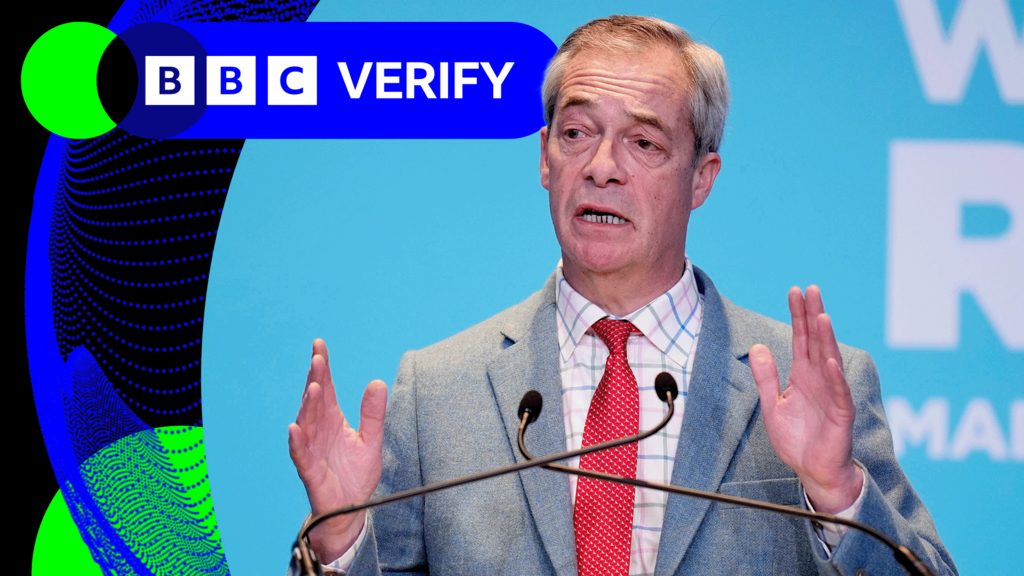
Reform UK leader Nigel Farage has once again ignited debate with a prominent claim regarding the linguistic landscape of Britain. During a recent interview, Farage asserted that "one million in the UK 'don't speak any English'." This statement, delivered with his characteristic directness, has drawn the attention of fact-checkers, with the BBC's Verify team stepping in to scrutinize the assertion.
The Claim Under the Microscope
Nigel Farage's pronouncements often serve as a barometer for certain segments of public opinion, particularly concerning immigration and national identity. The claim that a significant portion of the UK population is unable to speak English taps into deeply ingrained concerns about integration and the potential for societal division. However, in the realm of public discourse, such bold statements necessitate rigorous examination of the underlying data.
The BBC Verify report, published recently, sought to unpack the veracity of Farage's assertion. By examining available data and official statistics, the team aimed to provide clarity on the complex issue of English language proficiency across the United Kingdom.
Deconstructing the Numbers: What the Data Suggests
Fact-checking Farage's claim involves a careful analysis of census data and other relevant surveys. Official statistics, such as those collected by the Office for National Statistics (ONS) in England and Wales, provide insights into the languages spoken by residents. These surveys typically ask individuals about their ability to speak English and any other languages they may use.
While the exact figures can fluctuate based on the survey methodology and the specific question asked, the BBC's investigation into Farage's statement highlights the nuances involved. It's crucial to differentiate between individuals who may have limited English proficiency and those who, according to census data, do not speak English 'very well' or 'at all'.
The BBC Verify report specifically references data that indicates a substantial number of people in the UK do speak English. However, it also acknowledges that a portion of the population may indeed have limited English speaking abilities. The precise figure of 'one million' is what comes under scrutiny, with fact-checkers aiming to determine if this number is an accurate reflection of the available evidence or an exaggeration.
London's Linguistic Tapestry: A Case Study
As part of their analysis, BBC Verify also addressed a related point made by Farage during his interview on the BBC’s Political Thinking podcast. He pointed to examples in East London, suggesting that London Underground stations displayed foreign language signage. This observation, while seemingly anecdotal, was also subject to verification.
Transport for London (TfL) data, obtained through a Freedom of Information (FOI) request, revealed that two stations indeed featured dual-language signs. Southall station in West London displays Punjabi signage, while Whitechapel station in East London has signs in Bengali. TfL indicated that the Bengali signage at Whitechapel was installed following a request from the mayor of Tower Hamlets borough.
This specific example, while illustrating the presence of non-English languages in public spaces, does not directly validate or invalidate the broader claim about one million people not speaking English. It does, however, paint a picture of London as a diverse and multicultural city where multiple languages are present and accommodated.
The Importance of Context and Nuance
The debate surrounding language proficiency in the UK is often intertwined with broader discussions about immigration, integration, and national identity. Farage's claims, while potentially resonating with some audiences, often simplify complex societal realities.
Fact-checking such statements is vital for fostering informed public debate. It encourages a move away from sensationalism towards a data-driven understanding of the issues at hand. The BBC Verify report, by dissecting Farage's claim, serves as a reminder that political rhetoric, however powerful, should be grounded in verifiable evidence.
Understanding the number of individuals who may not speak English fluently is important for policymakers, educators, and community leaders. It informs the provision of language support services, the development of integration programs, and the overall approach to fostering social cohesion. Without accurate data, such efforts can be misdirected.
Looking Ahead
Nigel Farage's continued influence in British politics means his statements will likely remain under public and media scrutiny. The BBC Verify fact-check on his English language claim provides a valuable insight into the process of evaluating such assertions. As the UK continues to evolve as a diverse nation, the accurate understanding and representation of its linguistic makeup will remain a crucial element of public discourse.
The BBC's commitment to fact-checking, exemplified by the Verify team's work, is essential in navigating the often-turbulent waters of political communication. It empowers citizens with the information they need to form their own informed opinions, moving beyond soundbites to a more substantive understanding of the United Kingdom's social fabric.