Marco Rubio Warns of 'New Era in Geopolitics' Amidst Growing Transatlantic Tensions
Munich, Germany – As the world grapples with a rapidly shifting international landscape, United States Secretary of State Marco Rubio has underscored the dawn of a "new era in geopolitics" at the prestigious Munich Security Conference. His remarks come against a backdrop of increasingly stark pronouncements from European leaders about the fragility of the existing world order and widening divides with the United States.
A World Order Under Strain
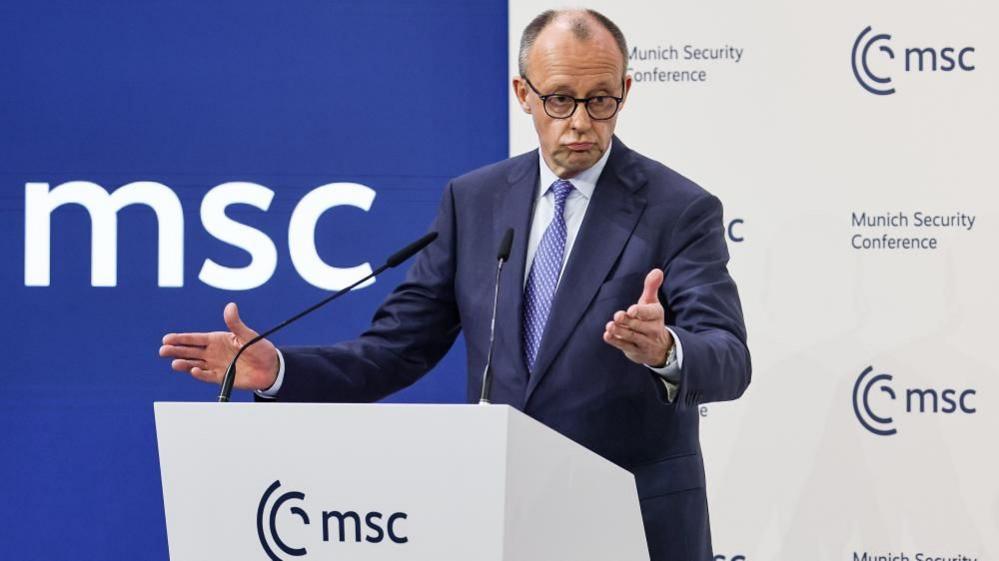
The annual security summit in Munich has been dominated by a palpable sense of unease, amplified by German Chancellor Friedrich Merz's blunt assessment that the "rules-based world order no longer exists." Merz's address painted a sobering picture of a global arena characterized by resurgent great power politics, where European freedoms are no longer a given and the need for greater self-reliance is paramount.
Adding to the gravity of the situation, Merz highlighted a "deep divide" that has opened between Europe and the United States, a sentiment echoed by Rubio's acknowledgment of a "new era." This rift has been exacerbated by recent actions and rhetoric from the U.S., including President Donald Trump's controversial proposals to annex Greenland and the imposition of tariffs on European imports. These actions have been perceived by many across the Atlantic as a significant erosion of trust with a key ally.
Transatlantic Trust in Question
The conference agenda reflects these deep-seated concerns, with European defense and the future of the transatlantic relationship taking center stage. Questions surrounding U.S. commitments to NATO have intensified, while Trump's overtures towards Greenland have been viewed as a watershed moment, undermining decades of established diplomatic norms and alliances. Trump's public statements, suggesting Greenland "wants us" and that negotiations are underway, have further fueled anxieties about U.S. intentions and the stability of existing partnerships.
Rubio, who was present for Merz's address and is slated to deliver his own keynote speech, offered a nuanced perspective. When pressed about whether his message to European counterparts would be more conciliatory than that of Vice President JD Vance a year prior – whose criticisms of European policies on free speech and immigration sparked significant transatlantic friction – Rubio acknowledged the evolving global context.
"The world is changing very fast right in front of us," Rubio stated. "We live in a new era in geopolitics, and it's going to require all of us to sort of re-examine what that looks like and what our role is going to be." This sentiment suggests a recognition within the U.S. administration of the need for a recalibration of international strategies and a fresh look at the foundational principles of global cooperation.
Europe's Call for Autonomy
The urgency for Europe to adapt is being met with calls for greater strategic autonomy. French President Emmanuel Macron, addressing the conference, reiterated his plea for Europe to "learn to become a geopolitical power." He emphasized that while the continent is already re-arming in response to Russia's full-scale invasion of Ukraine, a collective and accelerated effort is crucial.
Macron described the war in Ukraine as Europe's "existential challenge" and urged a firm stance against Russian demands, advocating instead for increased pressure to achieve a just peace. The discussion around a potential joint European nuclear deterrent, with "confidential talks" between Germany and France underway, underscores Europe's growing conviction that it must bolster its own security capabilities, moving away from traditional reliance on the U.S. nuclear umbrella.
Navigating a Multipolar World
The Munich Security Conference is taking place against a backdrop of multifaceted global challenges. Beyond the immediate concerns of the Russia-Ukraine war and the shifting U.S.-Europe dynamic, tensions between the West and China, alongside the potential for an Iran-U.S. nuclear deal, are also high on the agenda. These complex geopolitical currents necessitate a thorough re-evaluation of alliances, security architectures, and the very nature of international engagement.
Rubio's articulation of a "new era" serves as a stark reminder that the geopolitical landscape is not static. The era of predictable, rules-based international order, however imperfect, is being challenged by a more fluid and potentially volatile multipolar system. As leaders convene in Munich, the imperative is clear: to navigate these uncharted waters with clear-eyed realism, strategic foresight, and a renewed commitment to understanding and adapting to the evolving realities of global power.
The coming months will likely reveal how effectively the U.S. and its European allies can bridge their differences and forge a common path forward in this new and demanding geopolitical epoch.
